AI Floor Plan Optimization: Save on Renovation Costs
Renovation dreams can quickly turn into budget nightmares. Many homeowners start with an exciting vision, only to see costs pile up unexpectedly. In fact, the average homeowner overspends by 15-20% on renovations, often due to layout mistakes that could have been prevented. What if you could catch these expensive errors before a single wall comes down?
Discover how AI floor plan optimization is revolutionizing renovation planning. It acts as your intelligent design assistant, identifying issues before they become costly problems. Let's examine how real homeowners are saving, look at practical steps for implementation, and show you how to maximize your renovation budget without sacrificing quality. With the right analysis, you can plan with confidence. To see how AI can improve your design, you can upload your plan and get started.
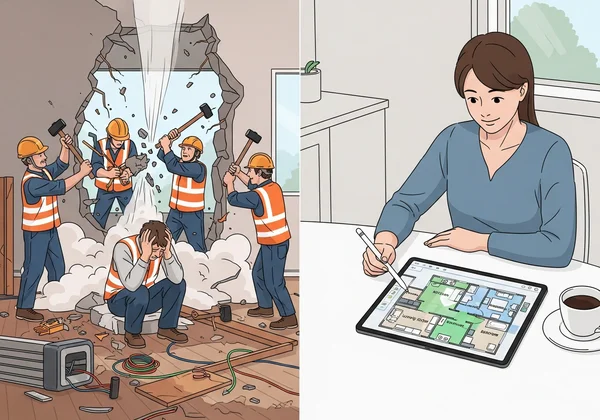
The High Cost of Renovation Mistakes
Understanding where your budget is most at risk is the first step toward protecting it. Renovation overspending isn't just about choosing expensive tiles or fixtures; it often stems from fundamental flaws in the initial layout plan. These mistakes can be subtle, but their financial impact is significant.
Common Layout Errors That Drain Your Budget
Several common layout mistakes consistently lead to budget blowouts. Common mistakes include creating poor traffic flow with awkward hallways, inefficiently using space that makes rooms feel cramped, and configuring the kitchen work triangle poorly. Other costly errors include ignoring natural light sources, which creates dark spaces, and placing plumbing and electrical outlets in inconvenient locations. Each of these issues may require expensive changes mid-project, such as moving walls, re-routing pipes, or re-wiring circuits.
The Domino Effect of Poor Planning
A single layout mistake rarely exists in isolation. It creates a domino effect that ripples through your entire renovation budget. For example, a poorly placed wall might obstruct a natural walkway. Fixing it might involve moving the wall, which then requires re-doing the flooring, repainting, and possibly adjusting the electrical plan. What started as a simple layout tweak has now become a multi-thousand-dollar problem involving several different tradespeople. This chain reaction is how small planning oversights spiral into major budget overruns.
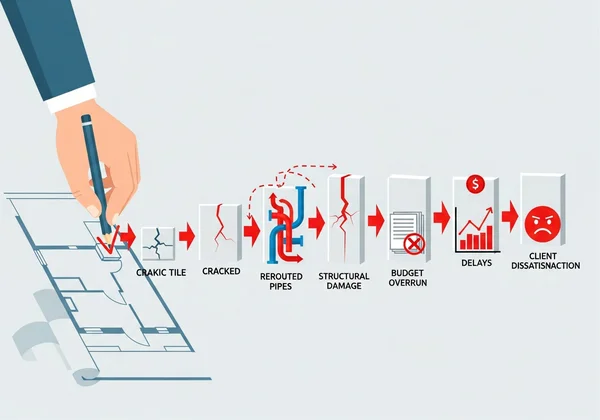
Hidden Costs in Traditional Design Approaches
Traditional design planning often relies on human experience alone, which, while valuable, can have limitations. Architects and designers might overlook minor details during manual reviews. Additionally, it can be difficult to visualize how a 2D drawing will translate to a 3D space. This can lead to "change orders" during construction—formal requests to alter the original plan. These changes are notoriously expensive, as they disrupt schedules and often require undoing completed work. The traditional approach lacks the data-driven certainty that an AI analysis can provide, leaving you exposed to these hidden costs.
How AI Floor Plan Optimization Prevents Costly Errors
The best way to avoid expensive mistakes is to prevent them from ever happening. This is where AI floor plan optimization becomes a powerful ally in your renovation journey. Instead of relying on guesswork, you can use advanced technology to analyze, refine, and perfect your layout before committing your budget.
Data-Driven Analysis Before You Build
Unlike drawing a plan from scratch, AI optimization tools like our platform analyze your existing layout. By uploading your current floor plan, the AI performs a deep, data-driven analysis based on established design principles. It checks for issues related to traffic flow, ergonomics, spatial balance, and accessibility. This is not about creative opinion; it's about applying proven rules to identify objective problems in your plan. The result is a detailed report that acts as a "second opinion" from a highly trained expert.

AI-Powered Suggestions That Maximize Space Efficiency
Wasted space is wasted money. An AI floor plan creator excels at finding opportunities to maximize every square foot. It might suggest repositioning a door to create a more usable wall for furniture, reconfiguring a closet to improve storage, or even shifting an entire room's orientation to capture more natural light. These intelligent suggestions help you achieve a more functional and spacious-feeling home without the expense of adding square footage. It turns a good layout into a great one.
Identifying Potential Issues Before They Become Expensive Problems
The true power of AI optimization lies in its predictive ability. The system can flag potential conflicts and problems that are easy to miss on a 2D blueprint. For example, it can identify a door that will clash with a cabinet when opened or a narrow hallway that will be difficult to navigate with furniture. By catching these issues in the digital planning phase, you can make adjustments with a few clicks. This is infinitely cheaper and faster than discovering the problem during construction, when a solution could cost thousands of dollars and cause significant delays.
Real-World ROI: Case Studies in Cost Reduction
The theory behind AI-powered savings is compelling, but the real-world results are what truly matter. By using a floor plan optimizer, homeowners and professionals are already preventing costly errors and achieving a significant return on investment. Here are a few examples of how pre-construction analysis leads to tangible savings.
Case Study 1: Kitchen Renovation That Saved $8,000
A family was planning a major kitchen remodel with a budget of $50,000. Their initial design included moving a load-bearing wall to create an open-concept space. Before hiring an engineer, they used an AI tool to analyze their plan. The AI suggested an alternative layout that achieved a similar open feel by simply reconfiguring the island and removing a non-structural partition. This smart adjustment provided excellent flow and functionality while avoiding the complex and expensive structural work, saving them an estimated $8,000 in demolition, engineering, and construction costs.
Case Study 2: Bathroom Layout Optimization Avoiding $5,000 in Changes
A DIY enthusiast designed a new master bathroom layout for their home. The plan looked great on paper. However, after uploading it for an AI analysis, the system flagged a critical issue: the proposed location for the new toilet was too far from the main soil stack. Moving the plumbing would require cutting through concrete slab and extensive re-piping, a surprise cost of over $5,000. Armed with this insight, they adjusted the layout to keep the toilet closer to the existing plumbing lines, completely avoiding the extra expense while still achieving a beautiful and functional design.
Case Study 3: Open-Plan Living Room That Eliminated $3,000 in Structural Work
A real estate developer was renovating a property to sell. Their architect proposed removing a central wall to create a large, open-plan living and dining area. The developer ran the "before" and "after" plans through an AI optimization tool. The analysis showed that a better sense of space could be created by simply widening the existing doorway into an arch and using clever furniture placement. This created a feeling of connection between the rooms without the need for a steel beam and costly structural engineering, saving the project over $3,000 and shortening the renovation timeline.
Implementing AI Optimization in Your Renovation Process
Integrating AI into your renovation plan is straightforward and incredibly effective. It's a simple step that adds a powerful layer of security to your budget and decision-making. Here is how you can seamlessly incorporate it into your workflow.
Step-by-Step Guide to Using AI for Budget Planning
Using an AI-powered tool is designed to be intuitive. The process typically involves three simple steps:
-
Upload Your Plan: Start by uploading your existing floor plan. Most tools, including our platform, accept common file formats like JPG, PNG, or PDF. You can also add notes about your goals, such as "I want an open kitchen" or "need more storage."
-
Analyze and Review: The AI engine will analyze your layout and generate a report highlighting potential issues and suggesting optimizations. You have full control to review these suggestions and decide which ones align with your vision.
-
Generate and Visualize: Based on the suggestions you accept, the tool generates a new, optimized floor plan. You can then see a visualization of the improved space, giving you the confidence to move forward. To see how easy it is, you can try our free tool today.
Integrating AI Suggestions with Your Renovation Timeline
The best time to use an AI floor plan optimizer is at the very beginning of your project, before you finalize designs or hire contractors. This "measure twice, cut once" approach ensures that the plan you give your build team is already vetted for efficiency and functionality. By making all the changes digitally upfront, you create a clear and conflict-free blueprint, which helps keep your renovation on schedule and prevents costly delays caused by mid-project changes.
Communicating with Contractors About AI-Optimized Plans
An AI-optimized plan is a powerful communication tool. When you approach a contractor, you are not just bringing them a vague idea; you are providing a detailed, professional-grade layout that has already been analyzed for potential flaws. You can walk them through the "before" and "after" versions, explaining why specific changes were made. This level of preparation shows you are a serious and organized client, builds trust, and helps ensure that your contractor fully understands your vision, leading to more accurate quotes and a smoother construction process.
Your Blueprint for Budget-Friendly Renovations
Renovating your home should be an exciting journey, not a source of financial stress. By leveraging the power of AI, you can move from hopeful guesswork to data-driven confidence. The high cost of renovation mistakes—from poor flow to inefficient space—can be drastically reduced by identifying and solving these problems before they ever reach the construction site. AI floor plan optimization acts as your digital design consultant, ensuring your budget is spent on creating the home you love, not fixing preventable errors.
Here's the bottom line: preventing problems before they happen saves you the most money. By reviewing AI-powered suggestions, you can unlock your home's true potential and avoid the domino effect of poor planning. You are in control of the final design, but with the added insight of powerful technology.
Ready to protect your renovation budget? Upload your floor plan today and see the difference AI optimization can make!
Frequently Asked Questions About AI Floor Plan Optimization
How much can I really expect to save with AI floor plan optimization? Savings vary depending on the project's scale, but it's common to prevent costs ranging from a few thousand dollars (by avoiding plumbing or electrical changes) to tens of thousands (by finding alternatives to major structural work). The primary value comes from avoiding expensive "change orders" during construction.
Can AI optimization eliminate all renovation costs? No, AI optimization focuses on preventing costs associated with layout flaws and inefficiencies. It does not control the cost of materials, labor, or unforeseen issues like hidden mold or foundation problems. However, it significantly reduces the risk of budget overruns related to poor design.
Is there a learning curve to using AI floor plan tools? Most modern AI tools are designed for ease of use. Platforms like our AI design tool feature a simple upload-and-analyze process that requires no technical expertise. If you can upload a photo to social media, you can use this tool to optimize your layout.
How does AI optimization compare to hiring a traditional designer? AI optimization is best seen as a powerful assistant, not a replacement for a human designer. It provides an excellent, data-driven "second opinion" on a layout. Many professional designers use these tools to validate their own ideas and quickly explore alternatives, while DIYers use them to gain expert-level insights without the high cost.
What file formats do I need for AI floor plan analysis? Most AI optimization tools are flexible and accept standard image files like JPEG and PNG, as well as PDF documents. You can typically use a clear photo of a hand-drawn sketch, a real estate listing's blueprint, or a file from an architectural program.